Penguin Manufacturing Game Lego based simulation for real flow
Why this game
On the shop floor, disruptions lurk in changeover times, batch sizes, BOM structures, queues, and priority shifts. The result: oscillation in WIP and lead times, orders wait while semi-finished products pile up, and teams run after the orders.
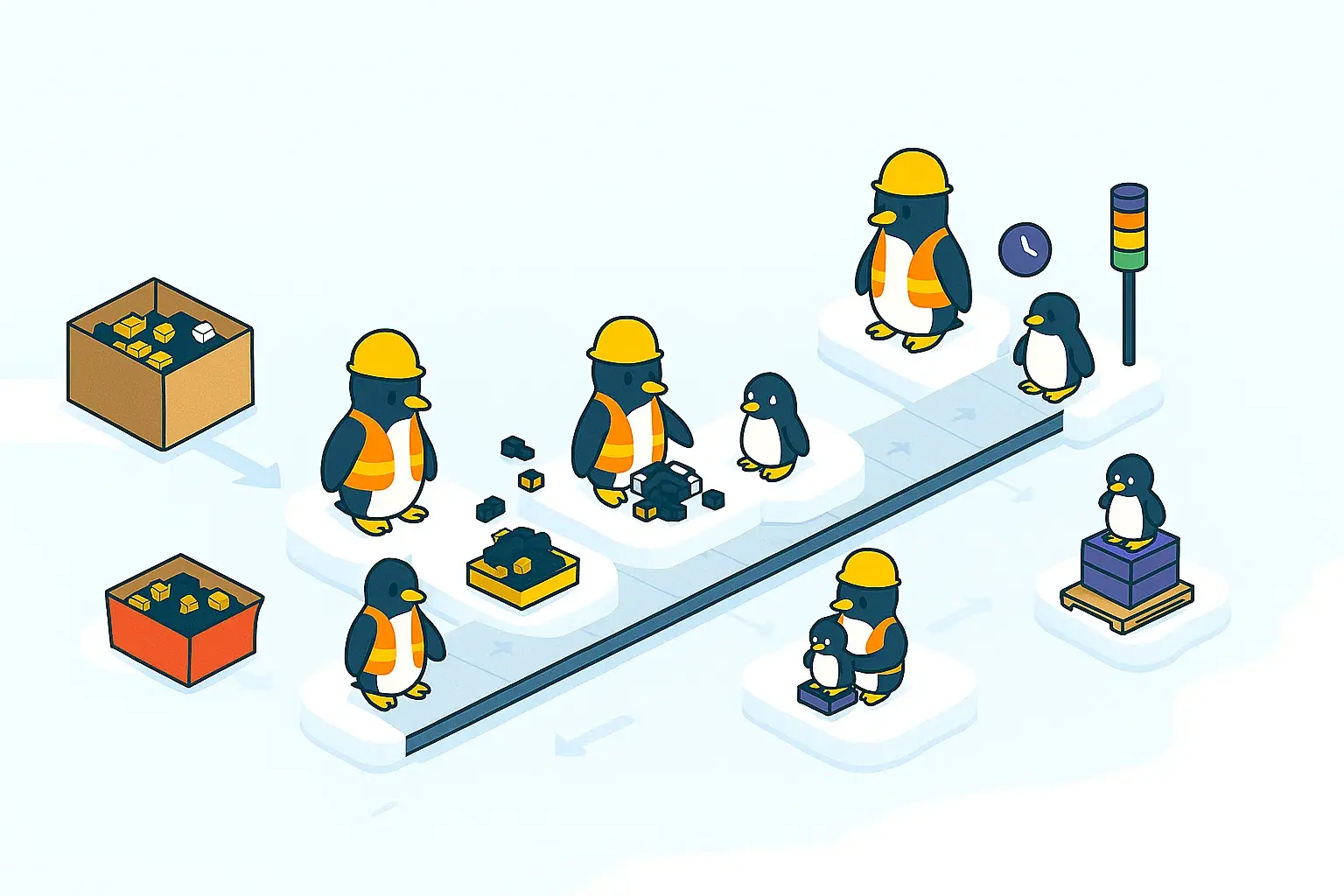
Our penguins bring rhythm to the factory. Think of a colony moving in tight formation: every step has a purpose, bottlenecks do not become overloaded, and materials flow instead of bouncing.
What you are going to do
Live, instructor-led workshop with LEGO, where teams collaboratively run a mini-factory. You play in rounds with real planning dilemmas and measurable results.
Round 1: The factory of today
- You plan and produce using standard MRP/ERP rules (forecast-driven, push, batches).
- You feel the pain: but you also learn how MRP works, queues at bottlenecks, urgent tasks, and rescheduling.
- Live KPIs: lead time, WIP, output/throughput, delivery reliability, changeover time impact, urgent orders.
Mini-block: Learning and recalibrating
- Concise explanation of Demand Driven Manufacturing: strategic decoupling (buffers), visual execution signals (red-yellow-green), WIP caps, and prioritising flow instead of "who shouts the loudest".
Round 2: The Demand Driven Restart
- Exactly the same scenario but now with Demand Driven rules.
- You see flow stabilising, changeover times being used more intelligently, lead times shorter, and less rescheduling.
- 1-to-1 comparison with round 1: what changes, where is the gain, what will you take with you tomorrow?
Analysis and feedback
- Joint debrief with scoreboard and lessons learned.
- Concrete verbeteracties.
Game mechanics in brief
- Roles: planning/scheduling, material supply, line operators, quality check, expedition.
- Proces: multiple stations with different cycle times, changeover times and capacity constraints.
- Signals: visual buffer zones (R/Y/G), priority on flow/constraint, pull triggers instead of push.
- Decoupling: strategic buffer positions in the material flow and before/after bottlenecks.
- KPI-scoreboard: throughput, delivery reliability, average lead time, WIP, % urgent orders, changeover losses, rescheduling events.
What you learn
- Decouple variation with smart buffer positions and WIP caps, so that bottlenecks deliver stably.
- Execution based on clear signals (visual priority) instead of planning noise.
- Optimize changeover times and batches for flow rather than just local efficiency.
- One language for operations and planning, which eliminates the blame game and speeds up decision-making.
- Faster delivery with less stress: shorter lead time, higher predictability, less urgency.
For whom
Production planners, schedulers, manufacturing/operations leaders, supply chain managers, team leaders, industrial engineering and continuous improvement/lean teams who want to shift the factory from push to flow.
Form and time
- On site, hands-on with LEGO, under the guidance of an experienced facilitator.
- Duration: 4 hours.
- Group size: ideally 6–18 players. More than 6 participants? We are happy to arrange a dedicated in-company session so that everyone can actively participate.
- Practical: space with tables for each team, flip chart/whiteboard. Materials (LEGO, scorecards) provided by us.
Results
- Shared understanding of why the current system oscillates and where the real bottlenecks are.
- Clear insight into how Demand Driven rules change behaviour and performance.
- Practical first steps (quick wins + checklist) that you can apply directly on the shop floor.
Ready to turn chaos into flow?
- Book your live session (LEGO, on location) If there are sessions scheduled, you can find them below.
- Larger group or your own date? Request a private session through us contact form
Our penguins don't just keep your production moving — they make it waddle in formation: shorter lead times, predictable output, and fewer fires to put out.
Onze nieuwste inhoud
Kijk wat er nieuw is in ons bedrijf!